


Free Shipping All Orders Over $95
There's no single clearance time for THC, since infrequent use may produce a positive urine screen for about 1 to 5 days while chronic heavy use can remain detectable for roughly 30 to 36 days. The answer depends on the specimen tested, whether the lab finds active THC or a metabolite, your dose and pattern of use, and the cutoff the lab reports against.
If you're reading this with a test date circled on a calendar, that range probably feels too wide to help. It's wide because How Long Does THC Stay in Your System is really four different questions wearing one label, and each one runs on its own clock.
You're waiting on a pre-employment screen. Or you ate a strong edible on Saturday, felt fine by Sunday, and got a random test notice on Monday. Or you smoked THCA flower that was sold as hemp and you're now wondering whether that counts. In each case, you want one number. A lab can't give you one number until it knows what it's measuring.
That's because "in your system" can mean four separate things. It can mean active THC circulating in blood. It can mean metabolites, the inactive breakdown products your body makes afterward. It can mean impairment, how you feel and function. And it can mean test detectability, whether a sample lands above a lab's reporting cutoff. Those four ideas overlap, but they don't start or end together.
Most workplace testing uses urine. Urine tests usually don't target intoxicating THC at all. They target THC-COOH, an inactive metabolite that lingers long after any high has faded. So a positive urine result generally points to prior exposure, not current impairment and not the exact hour you used.
Blood tells a different story. Active THC leaves blood comparatively quickly, so blood is better suited to recent exposure. Oral fluid, often called a saliva or mouth swab test, also leans toward recent use. Hair sits at the other end and can reflect a much longer history. Four specimens, four clocks.
A urine positive answers "was this person exposed at some point," not "is this person impaired right now."
Product labels add another wrinkle. THCA in raw flower isn't the same experience as THC, but heat from smoking or vaping converts THCA into THC. Once that happens, your body processes it the same way, and repeated sessions let THC-COOH accumulate. A person using a potent concentrate daily and a person who took one hit last month are not working from the same timeline, even if both products came from a legal hemp shelf.
So the useful question isn't "how many days until I'm clear." It's which test, which cutoff, and what pattern of use. Answer those three and the ranges in the sections ahead start to make sense. Skip them and any single day count you find online is a guess dressed up as a fact.
THC is lipophilic, which is a plain way of saying it prefers fat over water. After you inhale or eat it, THC enters your blood, then moves out of blood and into fatty tissue. Over time it trickles back into circulation in small amounts. Your liver converts that returning THC into metabolites, and your kidneys move those metabolites out through urine.
That storage and slow release is the whole reason detection outlasts the high. You're not waiting for one dose to wash straight through. You're waiting for stored compounds to redistribute, get converted, and finally drop below a lab threshold.
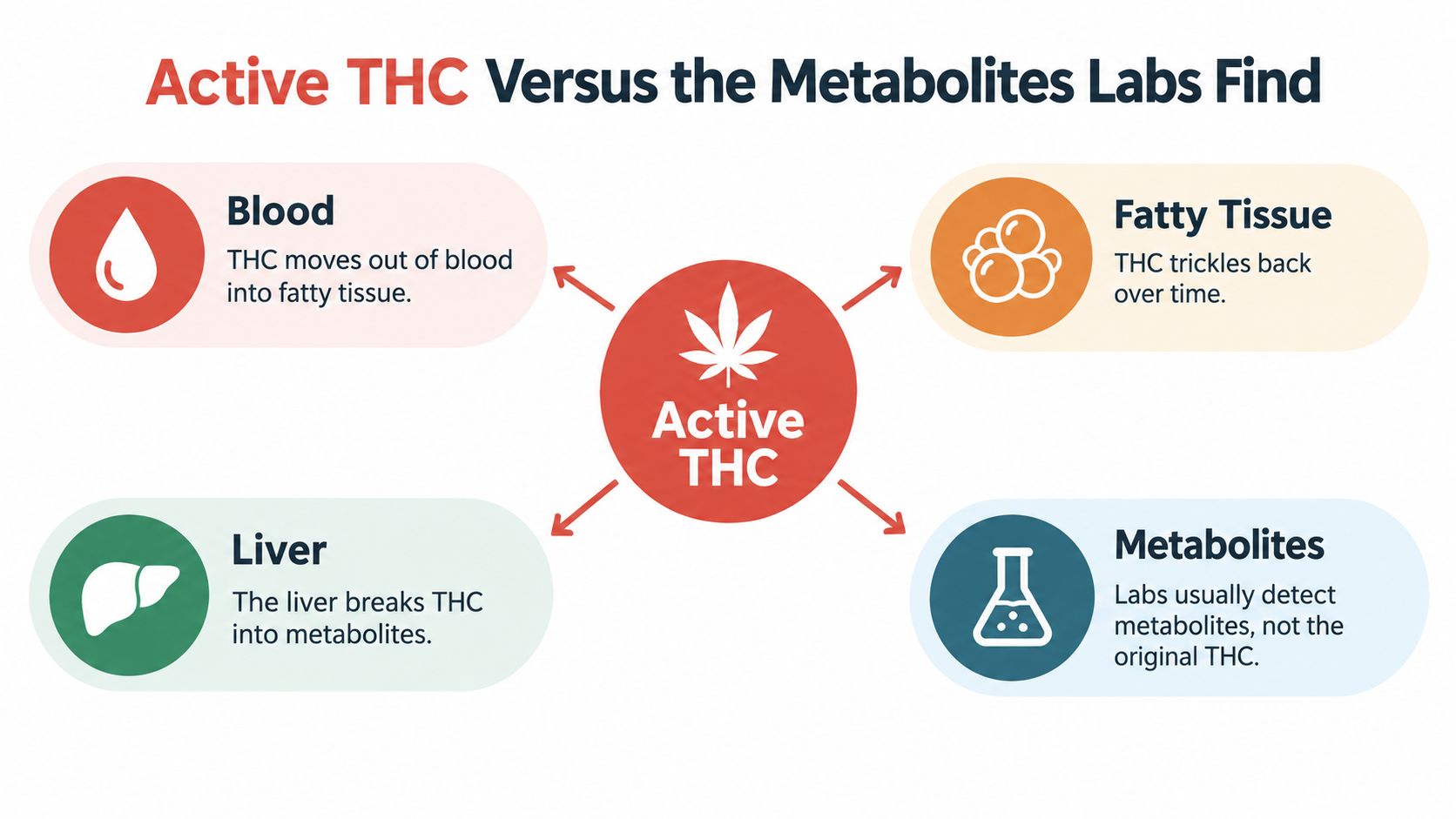
Parent THC is the compound that produces intoxicating effects. Labs looking at urine usually aren't hunting for it. They're measuring 11-nor-9-carboxy-THC, shortened to THC-COOH, plus a related form called THC-COOH glucuronide. Neither metabolite gets you high. Both stick around far longer than the parent compound, which is exactly why urine windows look so long compared with how long effects last.
A half-life is the time it takes a measured concentration to fall by half. It describes a decline, not a finish line. A pharmacokinetic review puts THC's rapid initial blood half-life at about 6 minutes and its much longer terminal half-life at roughly 22 hours, a gap that reflects THC shuttling between blood and lipid storage tissues, as detailed in the pharmacokinetic review of THC blood and plasma half-lives.
Plasma figures show the metabolite gap even more clearly:
Read those numbers carefully. Parent THC falls in hours. Its metabolites fall in days. And halving a concentration still leaves half of it present, then half of that, so a half-life never tells you the morning a test turns negative.
Route changes the early timeline too. In one controlled oral-dose study covered in that same review, urine THC-COOH peaked on average about 7.7 hours after a lower dose and 13.9 hours after a higher dose, with a terminal urinary elimination half-life of roughly 2 to 3 days. After a single use, THC-COOH may show up in urine within about 60 minutes, although appearance can take up to 4 hours, according to Mayo Clinic Laboratories guidance on marijuana metabolite testing.
The takeaway is simple. Any honest answer about How Long Does THC Stay in Your System has to name the chemical and the fluid. "THC" alone isn't specific enough.
Urine comes first because it's the most common workplace specimen and the one most day counts online are secretly describing. Federal guidance says infrequent marijuana use may produce positive initial urine results for approximately 1 to 5 days, per SAMHSA medical review officer guidance on urine detection periods. That same federal reference frames approximate urine windows as up to 3 days after single use, up to 4 days with moderate use, up to 10 days with heavy use, and 30 to 36 days with chronic, heavy use.
A close clinical summary lands in nearly the same place, describing up to 3 days after single use, about 5 days with moderate use, up to 10 days with daily heavy use, and roughly 30 days in chronic heavy users. Treat both frames as population estimates. They're useful for orientation. They are not a personal guarantee stapled to your calendar.
Approximate THC Detection by Specimen
| Specimen | Main target | Approximate window | What a positive suggests |
|---|---|---|---|
| Urine | THC-COOH metabolite | Days to weeks depending on use pattern | Prior exposure, not current impairment |
| Blood | Active THC | Shorter, recent exposure | More recent use than urine usually indicates |
| Oral fluid | THC itself | Shorter recent-use window | Recent exposure |
| Hair | Incorporated cannabinoid markers | Long historical period | Past pattern of exposure, poor for very recent use |
Blood generally has a shorter practical detection period than urine because active THC clears from blood relatively quickly while fat-soluble metabolites persist. That makes blood better suited to questions about recent exposure, though it still doesn't read impairment off a number.
Oral fluid testing typically emphasizes recent exposure and measures THC itself rather than the long-lived metabolite. Hair testing can reflect a much longer historical period, but it's a weak tool for very recent use and results are affected by hair growth, pigmentation, contamination, and testing protocols.
Several factors push a result toward the long end:
Dilution and assay cutoff levels can pull the other direction and shorten or alter a window. Two people can share a product on the same night and still test differently a week later. That's not a lab error. That's the biology and the cutoff doing exactly what they do.
Use the table to match a test type to what its result can and can't say. A urine positive can't tell an employer you were impaired at your desk. A hair result can't tell anyone what happened yesterday. Matching the specimen to the question matters more than memorizing a day count.
Frequency is the lever many underestimate. Counting hours since your last session feels logical, but with repeated use the question becomes how much has built up in fat tissue over weeks, not when you last felt anything. Stored cannabinoids release gradually, the liver keeps converting what returns to blood, and urine keeps carrying THC-COOH out long after you've stopped.
The image below captures why two people with the same last-use date can face very different timelines.
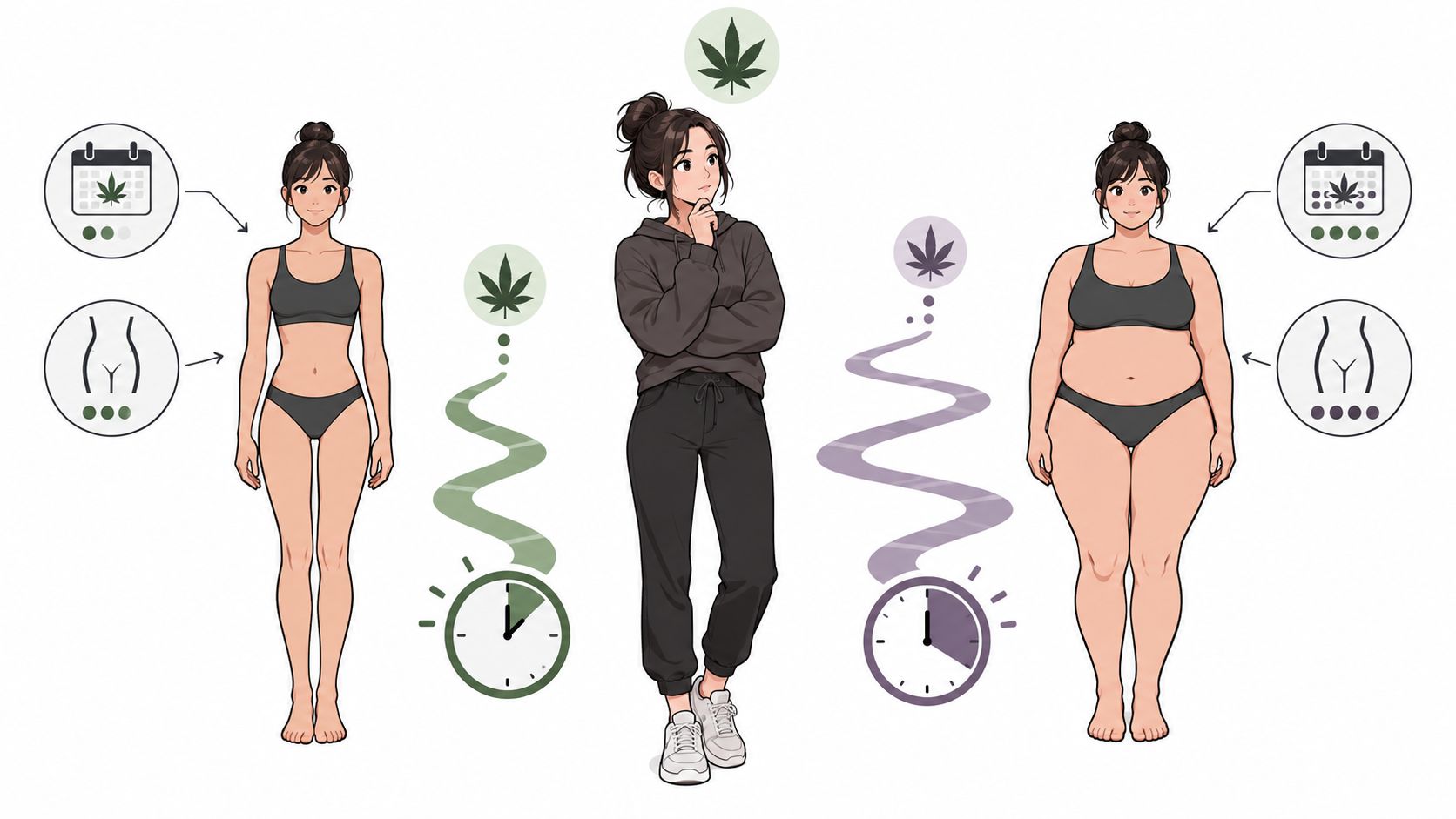
Clinical guidance describes the lipophilicity mechanism directly. Detection duration is driven largely by THC's redistribution from body fat followed by hepatic conversion to THC-COOH, and approximate urine windows run up to 3 days for single use, 4 days for moderate use, 10 days for heavy use, and 30 to 36 days for chronic heavy use, as summarized in SAMHSA clinical drug testing guidance on cannabinoid detection. Under some methods and thresholds, frequent users can remain detectable for months.
Notice what drives the spread. It isn't willpower or water intake. It's accumulated exposure meeting a specific cutoff.
None of these ranges describe how long you feel high. Effects fade while metabolites are still being released and excreted. Feeling completely sober and testing positive aren't contradictions. They're the normal state of affairs for urine testing.
The short video below walks through how frequency and body composition interact before you read the next section on interpreting actual results.
One honest limit belongs here. No reliable home method can guarantee rapid elimination. Only time, abstinence, and the specific test's cutoff determine the result. Anything sold as a shortcut is selling certainty that the underlying biology doesn't offer.
Two readings cause most of the confusion. People treat a negative as proof that THC has fully cleared, and a positive as proof of recent use or impairment. Neither reading holds up.
A test result is a comparison against a cutoff, a fixed concentration line. At or above the line, the lab reports positive. Below it, the lab reports negative, even if some metabolite is still present. That means "negative" really means "below this threshold in this sample," and "positive" means "at or above it." Change the line and the same person can flip results without using anything new.
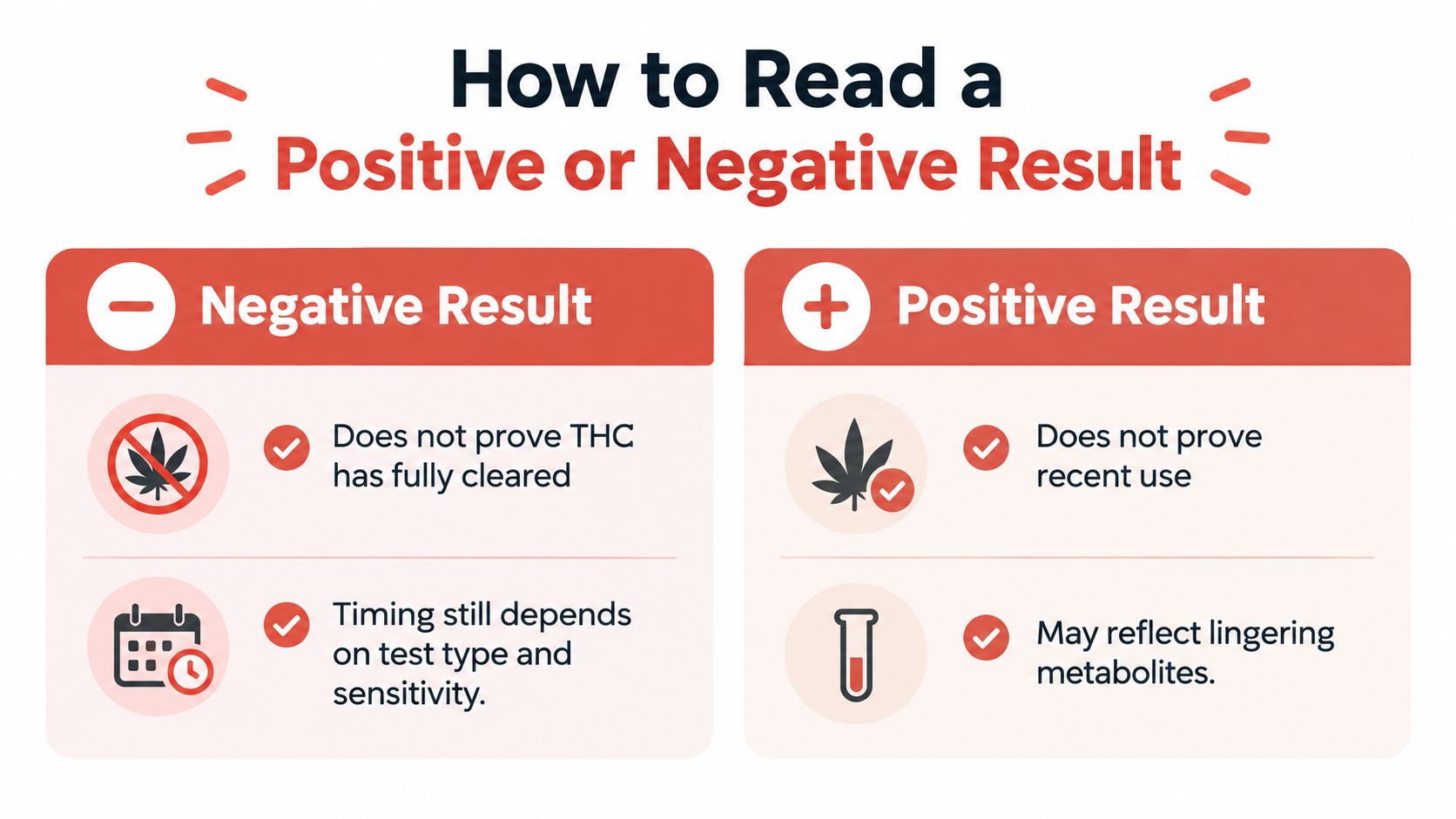
A federally used U.S. workplace screen commonly uses a 50 ng/mL initial cutoff with confirmation at 15 ng/mL. So a sample can fail a sensitive confirmation method after passing a less sensitive screen, or the framing of the panel alone can change the outcome. When someone quotes you a detection window without naming a cutoff, they're leaving out the variable that decided it.
Controlled abstinence research shows how long the tail can run. In one study, a participant required up to 77 days of abstinence to produce 10 consecutive negative urine samples at a 20 ng/mL cutoff, and BMI was associated with the timing of the last positive sample, according to the controlled study of cannabinoid excretion during monitored abstinence.
Two lessons sit inside that case:
A single negative during that phase doesn't mean you're permanently below the line. A single positive weeks into abstinence doesn't mean you used again. Urine generally measures THC-COOH, not impairment, while oral fluid measures THC itself and is oriented toward recent exposure, a distinction that also matters when comparing product types like those in this breakdown of Delta 8 versus THCA.
Practical rule: Never interpret a result until you can name the specimen, the cutoff, and the use pattern behind it.
Before drawing any conclusion, run a short checklist. Which specimen was collected? What cutoff did the lab use? How frequent and how potent was the use? What body composition and metabolism are in play? And finally, is the question about impairment or historical exposure? A single urine line can't date a session, and asking it to do so is how people end up arguing with a result that's technically accurate and practically misunderstood.
Most timelines you've seen online trace back to research that didn't use the products on today's shelves. Published elimination studies often used controlled cannabis cigarettes with known THC concentrations. Commercial flower, vapes, concentrates, and edibles vary substantially in dose, formulation, and how much THC you absorb. Researchers caution that findings from controlled cigarettes may not translate directly to those real-world products, as noted in the clinical and medico-legal review of cannabis drug testing.
That gap matters most with potent products. A larger absorbed dose from a concentrate or a high-potency edible can extend metabolite detection even when you feel no effects at all. Feeling clear-headed on Tuesday says nothing about the THC-COOH still leaving fat tissue on Friday.
Product choice and test choice interact:
Edibles deserve specific attention because oral absorption runs on a slower curve than inhalation. If you're comparing formats, it helps to understand how long edibles last as an experience, then remember that detectability is a separate, longer clock than the experience itself.
Unheated THCA isn't intoxicating in the way THC is. But smoking or vaping applies heat, heat converts THCA to THC, and from there your body builds the same THC-COOH. Repeated sessions let that metabolite accumulate. So a label showing a low Delta-9 figure doesn't tell the whole detection story once the product is heated and used regularly. Potency and repeated dosing can matter more than the product label alone.
Transparency about what's in a product becomes practical rather than decorative. Melt, a Los Angeles hemp brand, sells indoor and sun-grown THCA flower, Duo prerolls, AMF Blend disposables, and Melt Bites including 1000 mg gummies, with third-party testing and public lab reports, under the U.S. hemp limit of 0.3% Delta-9 THC, and it doesn't ship where THCA is prohibited. A lab report tells you the dose you're taking in. It doesn't shorten a detection window, and no product format makes heated THCA invisible to a urine test.
Detox drinks, excessive water intake, and exercise shouldn't be presented as reliable clearance methods either. They don't override dose, frequency, and cutoff. What you can control is knowing your product's potency, your use pattern, and which test you're facing. That's what determines which timeline is even relevant to you.
Start by naming the test. If you have paperwork, find the specimen type and, if it's listed, the cutoff. Urine at a standard workplace cutoff is a different planning problem than an oral fluid swab or a hair collection. Estimating days before you know those two facts is how people talk themselves into false confidence.
If a test is pending, the honest plan is abstinence and time. That's not a satisfying answer, but it's the only one the evidence supports.
When the goal is choosing a legal hemp product rather than preparing for a screen, shop with the same specificity:
Adults 21 and older can compare lab-tested THCA flower, prerolls, all-in-one devices, and gummies through an age-gated shop, check retail partners, and confirm shipping limits for their state before ordering. Keep one idea from everything above. A timeline for How Long Does THC Stay in Your System is only useful after you specify the chemical, the test, the dose pattern, and the person. Without those four, you're not reading a timeline. You're reading someone else's.
If you're shopping with detection windows in mind, start with products that publish exactly what's inside them. Melt offers lab-tested THCA flower, Duo prerolls, AMF Blend disposables, and Melt Bites gummies with public third-party reports, so you can check potency before you buy rather than guess after. Visit the age-gated shop to compare formats, confirm shipping for your state, and choose a dose that fits your plans and your calendar.
Your cart is currently empty.